
Your field reps are entering meetings blind, and your pipeline forecasts are still guesswork. Spreadsheets and manual check-ins waste hours every week, while managers lack the real-time visibility to redirect effort before deals slip. By the end of this guide, you'll have concrete criteria for evaluating location tracking, route visibility, and Salesforce data sync across five tools, plus a clear #1 pick for AI-powered team tracking in 2026.
We break down what actually matters when comparing field sales apps, from real-time location features to CRM integration depth, and give you a pricing benchmark at $65 per month per user to anchor your budget. You'll finish knowing exactly which platform fits your team size and which one to avoid.
What to Look For in Field Sales Team Tracking Apps
When evaluating field sales team tracking apps, focus on features that enhance visibility, streamline workflows, and integrate seamlessly with your existing CRM. The right tool should give managers a clear picture of daily field activity while giving reps tools that make their jobs easier, not harder.
Start by identifying the core capabilities that matter most for your sales team management approach. Real-time location tracking, route optimization, and geofenced check-in/check-out form the foundation of most tracking platforms. Beyond that, look for sales activity logging, visit reporting, and mobile CRM access that keeps customer data fresh.
Offline access and data synchronization are non-negotiable for teams working in remote areas with spotty connectivity. Reps should be able to log visits, update records, and capture signatures even without a signal, then sync automatically when they reconnect. This prevents lost data and keeps workflows moving regardless of location.
Pipeline visibility, performance analytics, and KPI monitoring turn raw field data into actionable insights. A good dashboard should show managers which reps are hitting targets, which territories need attention, and where deals are stalling. Territory management, task assignment, and schedule management keep daily operations organized and accountable.
Manager oversight extends beyond location alone. Compliance tracking, time and expense tracking, and photo proof of visit confirm that scheduled appointments actually happened and that reps are following company protocols. For teams already using Salesforce, native integration is critical so field data flows directly into your customer relationship management system without manual rekeying.
Real-Time Location and Route Visibility
Real-time location tracking allows managers to see where reps are at any moment, while route optimization ensures they take the most efficient paths between appointments. This visibility goes beyond simple oversight, it enables proactive coaching and faster response when issues arise in the field.
When a rep encounters unexpected traffic or a canceled meeting, managers can quickly reassign tasks or suggest alternative stops. Geofencing automates check-in and check-out when reps enter customer locations, eliminating manual status updates and providing reliable visit verification without extra effort from the salesperson.
Route optimization reduces travel time and fuel costs, which directly boosts sales rep productivity and frees up more hours for face-to-face selling. Instead of guessing which stops make sense, reps follow optimized sequences that account for traffic patterns, appointment windows, and geographic clustering. This means fewer miles driven and more customer conversations completed each day.
The practical benefits show up in daily planning. A rep covering five accounts in a metro area can group visits by proximity, while a manager reviewing the live map can spot coverage gaps in under-served territories. This level of manager oversight improves accountability and ensures customer service levels stay consistent across the entire sales team.
Salesforce CRM Integration and Data Sync
A field sales tracking app that syncs with Salesforce CRM ensures every visit, call, and update is recorded automatically, keeping your pipeline accurate and up to date. Two-way data synchronization for leads, contacts, opportunities, and activities means information captured in the field appears in Salesforce immediately, and changes made in Salesforce reflect back to the mobile app.
This integration eliminates manual data entry, which reduces errors and saves reps significant time at the end of each day. Automatic logging of calls, emails, and meetings builds a complete customer visit history without requiring reps to type notes twice. Sales leaders get real-time pipeline visibility, so forecasts reflect actual field activity rather than stale CRM records.
Mobile CRM access with offline capabilities is essential for reps working in basements, warehouses, or rural locations where connectivity is unreliable. They can view account histories, update opportunity stages, and capture visit notes offline, then sync later when a signal returns. This offline access ensures data integrity and keeps sales force automation running smoothly even in challenging environments.
For teams that rely on lead management and sales forecasting, seamless Salesforce integration means field activities directly influence pipeline health. Managers can spot stale opportunities, follow up on recent visits, and assign tasks based on real-time data. The result is a cleaner system of record and a sales team that spends less time on administration and more time closing deals.
1. Veloxy - Best Overall
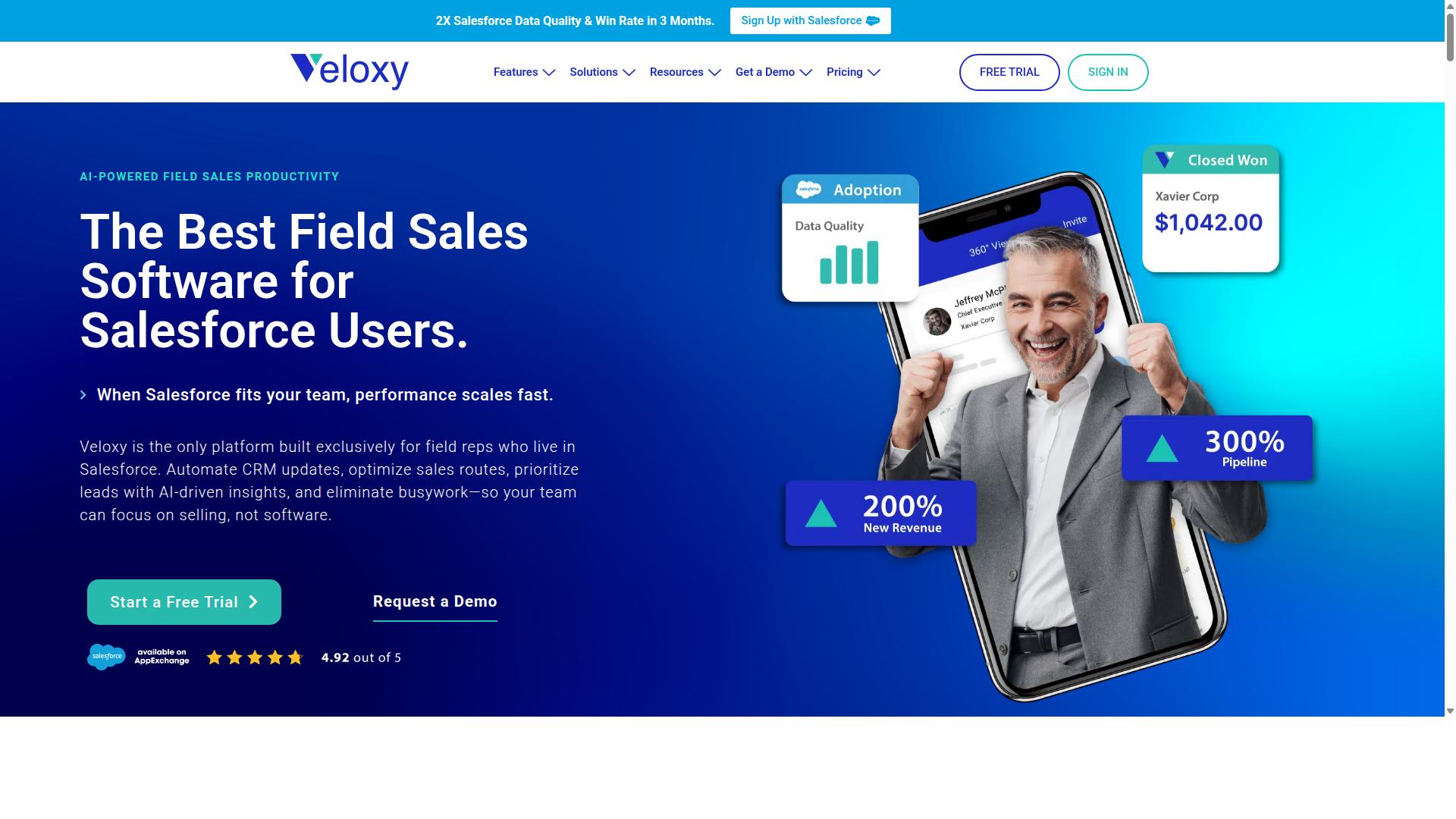
Veloxy stands out as the best overall field sales team tracking app for Salesforce users, combining AI-powered tracking with predictive forecasting to boost team performance. Unlike generic field sales apps, Veloxy is built exclusively for Salesforce, which means it fits directly into the CRM your team already uses every day.
This focus makes it a natural choice for field reps and sales managers who want real-time visibility into team activity without switching between multiple tools. Veloxy is available globally and is trusted by high-performing sales teams that need more than basic GPS tracking or check-in features.
The platform covers the full sales workflow, from automation and buying signals to lead qualification and pipeline management. Managers get sales analytics and guided selling tools that help reps focus on the right actions, while the system handles the heavy lifting of data entry and activity logging.
For teams evaluating field sales apps in 2026, Veloxy delivers a rare combination: deep Salesforce integration, AI-driven insights, and practical tools that improve both rep productivity and manager oversight.
AI-Powered Tracking and Predictive Forecasting for Salesforce Teams
Veloxy leverages artificial intelligence to automate data entry, provide real-time buying signals, and forecast sales with remarkable accuracy, giving Salesforce teams a competitive edge. The AI Sales Assistant automatically logs actions like calls, emails sent, opens, and replies, so reps spend less time typing and more time selling.
This automatic logging is a core part of Veloxy's value. Instead of asking reps to manually update records after every customer visit, the system captures activity as a natural step in the sales workflow. Sonny Hawkins from Comcast reports saving 60+ minutes a day using Veloxy's AI Sales Assistant software.
Beyond time savings, Veloxy feeds reps the right data at the right time based on their context, location, and upcoming events. This means field teams get relevant information before meetings without having to search for anything. Smart lead scoring and buying signals help reps prioritize accounts that are most likely to convert.
For managers, Veloxy Analytics provides more accurate forecasts based on historical analysis of biases. The analytics tools examine how different sales activities correlate to pipeline growth, revealing which behaviors most directly impact sales. This level of insight supports better sales team management and KPI monitoring across the entire territory.
Pricing and ROI: $65/Month Per User with 14-Day Free Trial
Veloxy is priced at $65 per user per month, with discounts for annual or multi-year commitments, and a 14-day free trial to test its impact on your team's productivity. Teams can save 25% with an annual subscription or 50% with a 3-year commitment, bringing the cost down to about $2 per day per user.
For larger organizations, company plans start at $899 per month for 25 team members, with an annual plan that saves 45%. This tiered structure makes Veloxy accessible whether you are equipping a small field team or rolling it out across an entire sales organization.
The ROI story is straightforward. Customers often double their sales productivity within three months of adoption, and the company backs this with a guarantee: if you don't get ROI in 3 months, you get 3 months free. Field sales reps typically pay off their annual Veloxy license in 1 to 2 months.
When you factor in reduced manual data entry, improved close rates, and better pipeline visibility, the math is compelling. Jose Rivera from Wex saves thousands of dollars a year in selling time and reports a 20 to 30% increase in sales engagement using Veloxy. For teams already invested in Salesforce, the per-day cost is a small price for that level of productivity gain.
2. SalesRabbit
SalesRabbit is a field sales tracking app known for its territory management and route optimization features, but its integration with Salesforce is limited compared to Veloxy. The platform was built specifically for door-to-door sales teams, with a strong emphasis on canvassing and lead generation workflows.
Sales teams in roofing, solar, telecom, and home services often turn to SalesRabbit for its territory mapping and route optimization capabilities. Reps can view assigned zones, plan efficient paths between stops, and track their coverage across a given area. The GPS tracking features allow managers to see where each rep is in real time, which supports better team tracking and manager oversight throughout the day.
The app includes check-in and check-out functionality, so reps can log their arrival at each location and managers can confirm visits were actually completed. This creates a useful record of customer visit history and supports compliance tracking for teams that need to prove their activity. Visit reporting is a clear strength here, giving field leaders a straightforward view of daily productivity.
SalesRabbit also includes a mobile CRM for lead management and some sales activity logging. Reps can capture leads on the spot, assign follow-up tasks, and keep notes attached to each prospect. However, the platform's approach to sales force automation is more focused on high-volume canvassing than on deep pipeline visibility or complex sales forecasting.
For teams evaluating field sales apps in 2026, SalesRabbit is a solid option when territory coverage is the main priority. That said, its Salesforce integration is not as seamless as some competing tools, which can create data synchronization challenges for organizations that rely on Salesforce as their primary system. Teams that need tight alignment between field activity and their broader CRM workflows may find the connection requires extra manual effort.
Pricing for SalesRabbit starts at $59 USD per user per month for the Team plan, with Pro available at $75 USD per user per month billed monthly. The platform offers a range of add-ons, including DataGrid AI, Mover Leads, Digital Contracts, and Weather tools, each priced separately. For roofing-specific needs, the RoofLink Pro CRM is available at $120 USD per user per month.
3. Knockio
Knockio focuses on simplifying field sales tracking with an intuitive interface and strong geofencing capabilities, though its CRM integrations are less extensive. The platform positions itself as an all-in-one field sales and service solution, combining door-to-door canvassing software with a field service CRM. This makes it a practical choice for teams that want to manage the full job lifecycle in one place, from initial contact through final payment.
For team tracking in 2026, Knockio's automatic check-in and check-out features stand out. The geofencing technology removes the need for manual entry, so managers get a clearer picture of where reps are during the workday. Alongside this, the app supports sales activity logging and visit reporting, giving field teams a simple way to document what happened at each stop without juggling multiple tools.
The platform also includes basic route optimization and real-time location tracking. These features help managers monitor movement across territories and make small adjustments when schedules shift. For teams focused on door-to-door sales in industries like fiber internet, home security, or solar, this combination of tools can keep daily operations moving smoothly.
However, Knockio may not be the best fit for organizations heavily reliant on Salesforce or other major CRMs. Its integration options appear limited compared to more open platforms. If your team needs deep data synchronization between field activities and a central CRM, you may find the connection lacking. For smaller teams that prefer an all-in-one approach, Knockio offers a credible alternative, but it is worth confirming that your existing tech stack aligns before committing.
4. BreezeFSM
BreezeFSM is a field service management solution that includes tracking features, but it is more geared toward service operations than pure sales teams. The platform is mobile-first and built for B2B companies in sectors like FMCG, Pharma, Manufacturing, and Distribution. It focuses heavily on operational execution rather than the full sales cycle. On the tracking side, BreezeFSM offers real-time geo-tagged attendance and live GPS tracking. Teams can also capture photo proof of visit, which helps managers verify that reps actually reached their assigned locations. The app supports journey planning and beat optimization, making it a solid choice for businesses with fixed routes and repeat visits. For sales-specific needs, BreezeFSM does include some CRM capabilities. Lead management and field-level stock management are present, along with instant order booking and payment collection that works offline. These features make it adaptable for sales teams, especially those managing distributors or retail outlets. However, the platform is not built around pipeline visibility or sales forecasting. Teams that rely heavily on lead scoring, deal stages, and revenue projections may find the sales layer thinner than expected. Adapting BreezeFSM for a full sales workflow often requires extra configuration to bridge the gap. The offline mode and multilingual support, including Indian languages, are practical advantages for field teams in varied regions. Expense claim management and reporting dashboards round out the operational toolkit. For organizations where service compliance matters as much as selling, BreezeFSM can work well. That said, sales leaders who want end-to-end team tracking tied directly to revenue outcomes may need to supplement it with additional tools. It is a capable field service platform, but it is not a dedicated sales force automation solution. Teams should weigh their priorities between operational tracking and sales pipeline management before committing.5. RepMove
RepMove offers a straightforward platform for tracking field sales activities, with an emphasis on time and expense tracking, though it lacks advanced analytics. The tool provides basic GPS location features and simple check-in/check-out capabilities for reps in the field.
For managers who need basic oversight of daily activity, RepMove covers the essentials. You can see where your team members are, confirm they arrived at scheduled stops, and log customer visit history without digging through complex menus. The interface is designed to be simple, which can reduce training time for new hires.
RepMove also functions as a field sales CRM with territory management and sales pipeline tracking. It includes voice-to-text note capture and route optimization tools, which help reps organize their day more efficiently. Some users will appreciate the document storage and emailing capabilities built into the platform.
However, teams looking for deep CRM integration or sophisticated performance analytics may find RepMove limited. The platform does not appear to offer the same level of real-time dashboard reporting or KPI monitoring found in more comprehensive field sales apps. This makes it better suited for smaller teams that need practical tracking without excessive complexity.
RepMove serves outside sales and field sales professionals across industries like construction supply, equipment rental, and medical devices. A 7-day free trial is available with no credit card required, which makes it easy to test. In recent review rankings, RepMove scored well on customer satisfaction, though its feature set remains more focused on core tracking than on advanced sales management.
How to Choose the Right Option
Choosing the right field sales tracking app depends on your team size, budget, and the criticality of Salesforce integration. The best field sales apps in 2026 solve real workflow problems, not just location tracking. Start by mapping your current sales process, then match it against what each tool actually delivers.
Begin with a clear list of non-negotiables. Real-time location, route optimization, and visit reporting should top the list for most teams. If your managers spend hours calling reps for status updates, you need stronger GPS tracking and check-in features. If your reps waste time driving between accounts, route optimization becomes your priority.
Teams already running Salesforce should prioritize tools that integrate natively. A mobile CRM that syncs visit data, activity logs, and customer history directly into Salesforce removes double entry and keeps pipeline visibility accurate. Seamless Salesforce integration matters more than any standalone feature for these teams.
Scalability and ease of use round out the evaluation. A tool that works for five reps should still function well at fifty. Look for dashboards that managers actually want to open daily, with KPI monitoring and performance analytics that require no training to read.
Team Size and Budget Considerations
For small teams, per-user pricing is critical, while larger teams may benefit from company plans that offer volume discounts. A five-person team paying per seat needs predictable monthly costs. A twenty-five-person team should compare aggregate pricing against individual licenses to find the better deal.
Calculate total cost of ownership, not just the sticker price. Include setup fees, training time, and any hardware requirements. Also consider the cost of time saved when reps stop manual logging and managers stop chasing status updates. These productivity gains often justify the subscription on their own.
Veloxy offers a straightforward per-user rate of $65/month per user, with savings available on longer commitments. Teams can save 25% with an annual subscription or 50% with a three-year commitment. A 14-day free trial lets you test the full-featured field sales app before paying anything.
For larger organizations, Veloxy provides company plans at $899/month for 25 team members, with an annual plan saving 45%. That brings the cost to roughly $2 per day per user, which is competitive for a full field sales solution. Veloxy also backs its value with a simple guarantee: if you do not get ROI in 3 months, you get 3 months free.
Final Verdict
For Salesforce-centric field sales teams, Veloxy is the clear winner due to its AI-driven features, seamless integration, and proven ROI. While other field sales apps offer solid GPS tracking, route optimization, and visit reporting, none are built exclusively for reps who live in Salesforce. That singular focus makes a measurable difference in daily workflow and manager oversight.
Veloxy customers report that after three months they double their sales productivity, double pipeline and revenue, and effectively pay for their annual Salesforce subscription. Users also spend 90 to 95% of their time on activities that produce sales, compared to only 30 to 35% before adopting the platform. These are the kinds of outcomes that matter when you are evaluating sales team management tools for 2026.
The platform delivers what modern field teams need: real-time location visibility, geofencing, check-in and check-out capabilities, photo proof of visit, and automated sales activity logging. It combines GPS tracking with pipeline visibility and performance analytics in one dashboard, so managers get KPI monitoring without juggling multiple apps. Offline access and data synchronization keep reps productive even in remote territories.
Pricing transparency sets Veloxy apart as well. The company guarantees that no other field sales app on the market offers as many critical features at this price point. That combination of depth and affordability is rare among mobile CRM and sales force automation tools.
Veloxy holds strong ratings across major review platforms. G2 recognizes it as a Highest Performer with enterprise reviews at 4.86, mid-market reviews at 4.71, and small business reviews at 4.76. It also carries more than 190 reviews on Capterra and over 200 reviews on Salesforce AppExchange, with top software review sites recommending it for field sales teams.
If you are ready to improve sales rep productivity and manager oversight in 2026, take advantage of the 14-day free trial. It gives your team time to test the AI-powered tracking, predictive forecasting, and territory management features firsthand. For further inquiries or a personalized demo, contact Veloxy directly through their website. The free resource, Samir's Big Blue Book of Field Sales, is also available to help you refine your field sales strategy.
Recommended Resources: