
Most compliance teams face a real choice right now between ServiceNow and Process Street when they need both policy control and workflow automation. Some tools force you to stitch separate systems together for document management, workflow tracking, and audit evidence. Others bundle these functions so teams can prove compliance without extra work.
By the end of this article you will see how each platform handles document management and policy control, workflow automation with AI monitoring, and audit-ready evidence. You can then decide which solution fits your team size and compliance requirements.
Quick Verdict: Process Street vs ServiceNow for Compliance Management
Process Street delivers 30% faster documentation and 75%+ reduction in setup time for teams needing immediate compliance workflows. The platform offers clear advantages for organizations under 5,000 records or requiring instant evidence for ISO 27001 and SOC 2 requirements.
Speed-to-value favors Process Street for most compliance teams. The platform reaches audit readiness faster than enterprise alternatives. Setup complexity stays minimal with pre-built templates for regulatory standards.
ServiceNow suits larger enterprises with heavy IT service management overlap. Organizations managing complex IT infrastructures often find its broader GRC capabilities align with existing service desk processes.
Audit-readiness differs between platforms. Process Street provides immediate evidence collection for standard compliance frameworks. ServiceNow requires more configuration time for similar readiness levels.
Teams under 5,000 records benefit from Process Street's streamlined approach. The platform supports SOC 2 Type II certification requirements with minimal setup overhead. ISO 27001 compliance becomes achievable within days rather than weeks.
Process Street holds certifications including HIPAA compliance with BAA available upon request. The platform maintains GDPR and CCPA compliance standards. AWS CIS compliance adds another layer of security validation.
Enterprise organizations with existing ServiceNow investments may prefer staying within that ecosystem. Process Street works better for companies seeking dedicated compliance functionality without broader IT service management complexity.
At a glance: how Process Street compares to ServiceNow on the features that matter most.
| Feature | Process Street | ServiceNow |
|---|---|---|
| Compliance Management | ✓ | ✓ |
What Is Process Street?
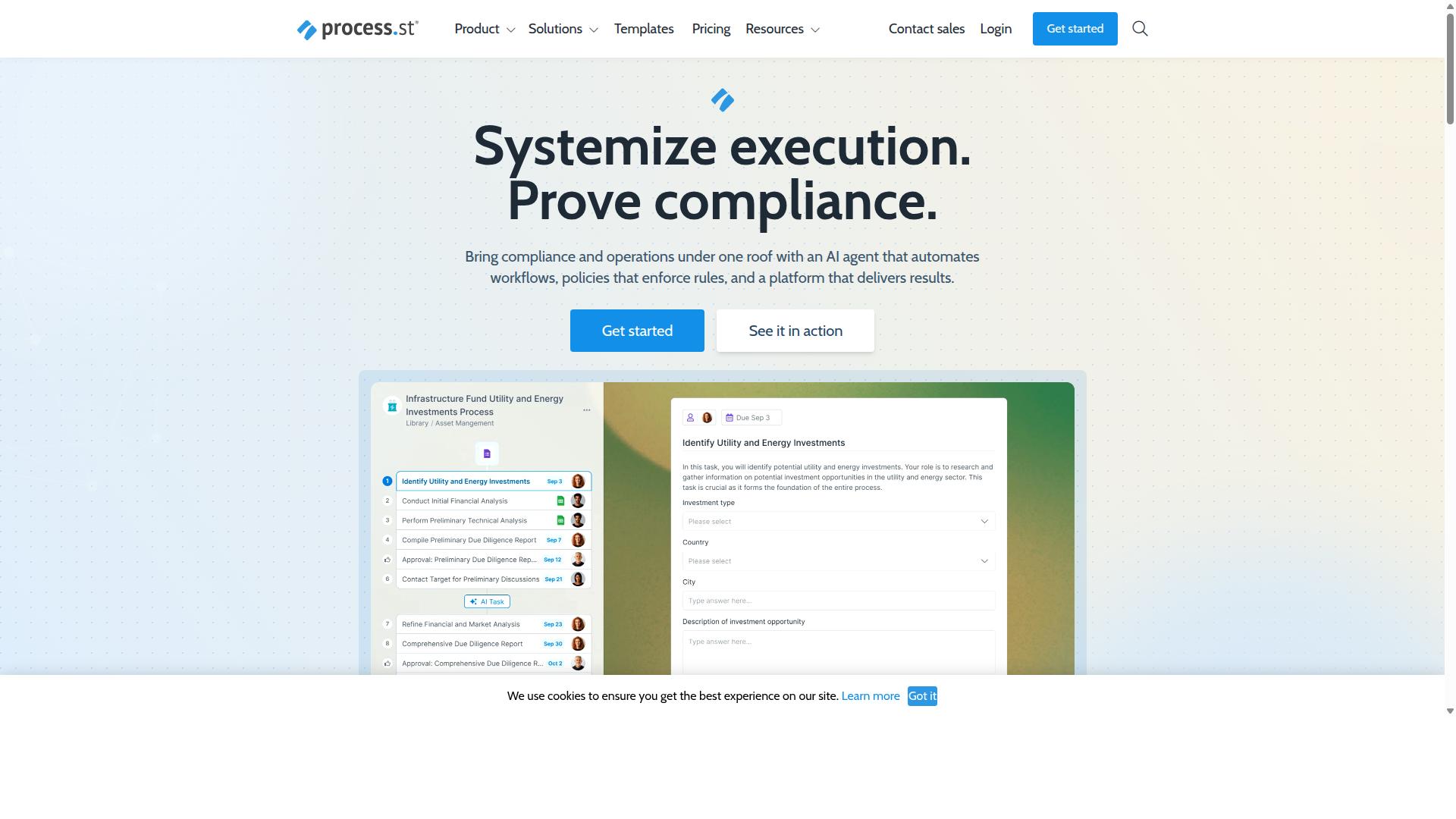
Process Street is a compliance operations platform that turns policies into AI-powered workflows with version-controlled checklists.
The platform serves 3,000+ customers and 1m+ users across industries. It automates business processes, enforces policies, and delivers audit-ready proof through three core products.
Docs handles document management and policy control. Organizations maintain version control while distributing approved procedures to the right teams.
Ops provides workflow automation and process orchestration. Teams execute tasks with built-in oversight, reducing manual handoffs.
Cora functions as an AI compliance and risk agent. It monitors processes and flags potential issues before they escalate.
Role-based access ensures each team member sees only the information they need. Notifications and escalations keep work moving when deadlines approach or approvals stall.
Integrations connect through automation apps. These connections allow data to flow between compliance systems without manual entry.
Companies standardize processes and prove compliance through audit trails. This structure supports regulatory compliance across multiple frameworks without adding administrative overhead.
What Is ServiceNow?
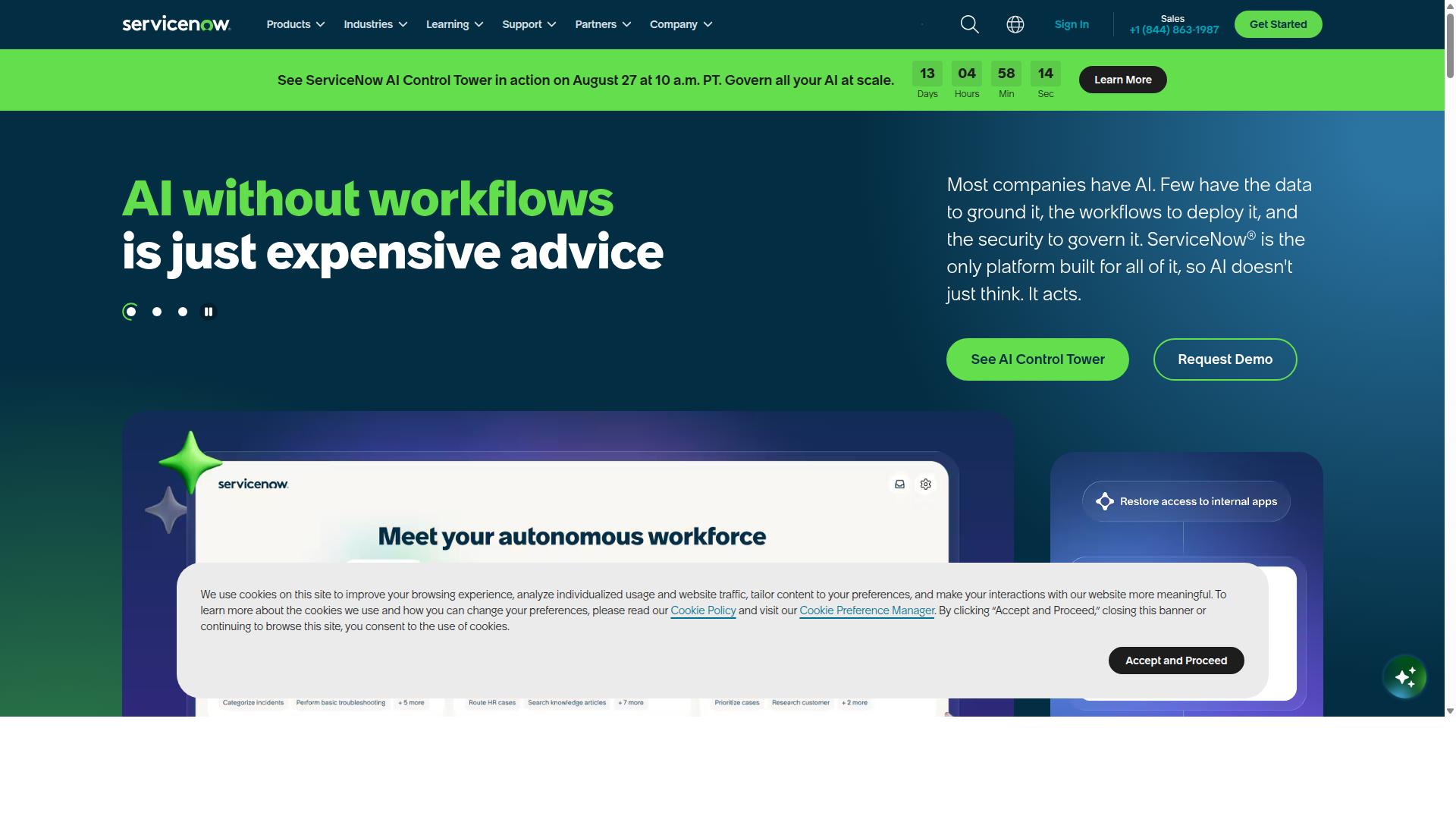
ServiceNow is an enterprise platform whose GRC module centralizes risk, policy, and audit processes within a broader ITSM suite. The system supports organizations managing compliance requirements across multiple regulatory frameworks through integrated tools.
Risk assessment features help teams identify potential issues before they become problems. The platform provides structured approaches to documenting and tracking various compliance obligations.
Control testing capabilities allow organizations to evaluate their existing safeguards against established standards. Users can create structured evaluation processes to verify whether controls are operating as intended.
Reporting analytics provide visibility into compliance status across different departments and time periods. The system generates summaries that help stakeholders understand current standing against regulatory requirements.
Many enterprises use ServiceNow when they need to connect compliance activities with IT service management workflows. The platform serves organizations that already rely on its core ITSM functionality for other operational needs.
Implementation typically requires significant configuration to align with specific industry requirements and organizational structures. The modular approach allows companies to expand usage gradually across different compliance domains.
Features Compared
Side-by-side evaluation of each platform's core capabilities reveals where each excels.
Compliance management requires tools that handle documentation, automation, and audit readiness at enterprise scale. Both platforms deliver these functions through different approaches and feature sets.
ServiceNow operates as a broad enterprise platform with GRC modules layered on top. Process Street focuses specifically on compliance workflows with purpose-built components.
Document Management & Policy Control
Process Street's Docs product enforces ISO 9001, SOC 2, SOX, and FDA policies with full governance and automatic versioning.
Document control becomes critical when organizations must prove policy adherence during audits. Process Street delivers 30% faster documentation through structured templates and streamlined workflows.
Role-based permissions ensure only authorized users can access or modify sensitive compliance documents. Approval workflows route documents through designated reviewers before publication.
ServiceNow provides document management capabilities as part of its broader platform. These features exist within a larger system designed for multiple enterprise functions beyond compliance.
Version control and policy enforcement operate differently across both platforms. Organizations focused primarily on compliance documentation may find dedicated solutions more efficient.
Workflow Automation & AI Monitoring
Process Street converts static policies into AI-powered workflows that automatically assign tasks and escalate overdue items.
Workflow automation transforms compliance requirements from manual checklists into systematic processes. Process Street's Ops orchestrates tasks across automation apps and automation actions.
AI monitoring tracks regulatory changes and flags compliance risks before they escalate. Automated task assignment ensures accountability while escalation rules prevent items from falling through cracks.
ServiceNow's Flow Designer handles workflow creation within its broader ecosystem. The platform supports automation across various business functions, including compliance processes.
Integration capabilities extend both platforms through their respective APIs and connector ecosystems. Process Street connects with Zapier, Microsoft Power Automate, Tray.io, and Make.
Audit-Ready Compliance Evidence
Process Street captures time-stamped evidence for every checklist step, producing audit-ready proof for SOC 2 Type II and ISO 27001 audits.
Evidence collection happens automatically as team members complete compliance tasks. Each action receives a timestamp and user attribution that auditors can verify.
Remediation tracking follows issues from identification through resolution with documented steps. Compliance dashboards provide real-time visibility into control effectiveness and outstanding items.
ServiceNow includes audit functionality within its GRC suite. These features support evidence gathering and reporting for various compliance frameworks.
Audit readiness requires consistent processes rather than ad-hoc documentation efforts. Platforms that embed evidence collection into daily workflows reduce the burden of audit preparation.
Pricing Compared
Process Street offers three tiers, Startup, Pro, Enterprise, each with explicit user and automation limits. The structure aligns well with compliance management needs across different organization sizes. ServiceNow pricing follows a different model that typically scales with module complexity and user count.
Startup caps at 5 users, 10 guests, and 100 automation actions per month. These boundaries suit smaller teams working through initial regulatory compliance requirements. The plan includes unlimited workflows and tasks alongside a 14-day free trial on the Pro plan without requiring a credit card.
Pro lifts restrictions to custom users with custom automation actions monthly. This tier supports growing compliance teams that need custom users, guests, and flexible automation actions. The plan maintains unlimited workflows and tasks while expanding Data Set records to 10,000 entries.
Enterprise removes all caps and includes SSO, SCIM, and a dedicated success manager. Organizations managing complex SOX compliance, GDPR requirements, or HIPAA workflows typically select this tier. Unlimited Public API access and custom Data Set records accommodate large-scale audit trails and evidence collection needs.
ServiceNow pricing generally requires consultation and often bundles multiple GRC modules. Process Street's transparent limits provide clearer budgeting for compliance management projects. Teams can evaluate exact user counts and automation requirements against their current risk assessment and control testing volume.
Who Should Choose Process Street
Teams in Operations, HR, Finance, and Compliance seeking faster policy rollout and lighter IT overhead will benefit most. These departments often need quick deployment without heavy infrastructure requirements.
Process Street serves teams across Operations, Customer management, Compliance, Human resources, Finance, IT and security. The platform supports organizations in Financial services, Real estate, Manufacturing, Healthcare, Professional services, Technology, Capital markets, and Property management.
Use cases include Employee onboarding, Client onboarding, ISO compliance, Quality tracking, Document control, and Custom workflows. These capabilities align well with organizations managing fewer than 5,000 records who need straightforward compliance processes.
Research suggests that teams standardized on Process Street experience significant setup-time reduction compared to enterprise alternatives. This advantage proves valuable for mid-market organizations in regulated industries.
Financial services, healthcare, and professional services firms often require rapid compliance implementation. Process Street addresses these needs with streamlined workflows that reduce technical complexity and accelerate deployment timelines.
Who Should Choose ServiceNow
Large organizations already invested in ServiceNow ITSM and requiring deep IT change-management integration may prefer its GRC module.
ServiceNow operates as enterprise software focused on IT service management and broader platform capabilities. The GRC module sits within this larger framework and connects to change management processes that many IT departments already use.
Heavy custom scripting requirements often emerge in complex environments. ServiceNow supports these needs through its development tools and configuration options that allow teams to build specialized workflows.
Established ServiceNow footprints create natural pathways for compliance initiatives. Organizations with existing implementations may find value in extending their current platform rather than introducing separate compliance management tools.
Regulatory compliance demands in highly regulated industries sometimes align with ServiceNow's integrated approach. The platform handles multiple compliance frameworks through a single system that connects to other IT processes and data sources.
Teams managing extensive incident tracking alongside compliance requirements may benefit from ServiceNow's unified environment. This setup reduces the need to maintain separate systems for different operational needs.
Complex environments with multiple integration points often require the type of customization ServiceNow provides. Organizations with dedicated development resources can leverage these capabilities to address specific compliance scenarios.
Final Verdict
Process Street wins for mid-market teams that need SOC 2 Type II, ISO 27001, and GDPR evidence without months of implementation. The platform delivers compliance management through straightforward workflow automation that reduces setup time by 75% compared to traditional enterprise solutions.
Teams achieve 30% faster documentation while maintaining the audit trails required for regulatory compliance. Process Street integrates with AWS Marketplace, allowing organizations to start evaluations quickly through existing procurement channels.
Support response times average 5 minutes through in-app chat, helping teams resolve questions during critical compliance periods. This responsiveness supports the 98% customer rating reported across user feedback.
ServiceNow offers extensive enterprise features that may exceed requirements for many mid-market compliance programs. The additional complexity often extends implementation timelines beyond what smaller teams can accommodate.
Process Street focuses specifically on compliance management workflows that matter most to growing organizations. The platform provides role-based access controls and approval workflows without requiring extensive configuration or ongoing technical support.
Organizations ready to evaluate Process Street can contact sales through AWS Marketplace or the in-app chat feature. These direct channels allow teams to assess fit against their specific compliance requirements before making a commitment.
Recommended Resources: