
Budget season forces a hard question: what should goal setting software actually cost? Seat-based plans punish growing teams, while flat fees hide limits on reviews, analytics, and 1-on-1 tools. Knowing the real structure matters before you sign a 2026 contract.
This guide breaks down what HeyRamp costs across monthly, yearly, and enterprise plans, then explains what drives pricing in this category and which features come included. By the end, you will know whether HeyRamp fits your team size and budget, and how to test it free.
What Is HeyRamp? Goal Setting Software for Teams Explained
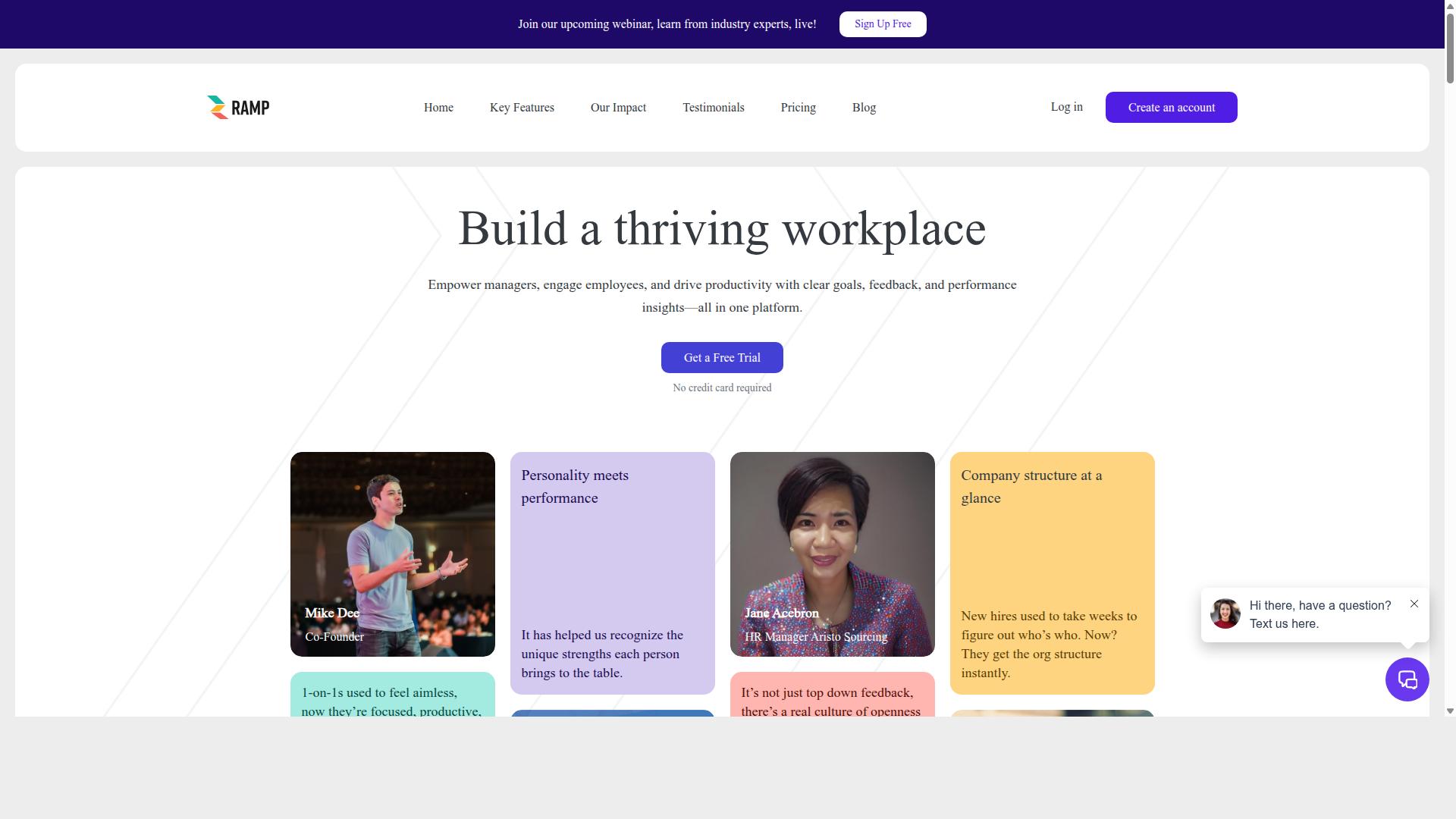
HeyRamp is a productivity platform that combines goal setting, performance management, and employee engagement into a single tool for teams. Instead of juggling separate apps for goals, reviews, and feedback, teams work from one place.
The platform is built around three outcomes: enableing managers, engaging employees, and driving productivity. Clear goals, structured feedback, and performance insights sit together, so progress stays visible.
HeyRamp is available globally as online software, which means distributed and in-office teams can use it the same way. For buyers comparing goal setting software, that scope matters when weighing team pricing and subscription tiers.
Who HeyRamp Serves: Leadership, Managers, HR, and Individual Contributors
HeyRamp is designed for leadership, line managers, human resources, and individual contributors within organizations seeking improved performance management and team development. Each group uses the platform differently, and that shapes how a team evaluates cost.
For leadership, the value is alignment and visibility. Executives need to know whether department goals ladder up to company objectives, and they want analytics that show progress without chasing spreadsheets. One shared platform reduces the reporting overhead that grows with headcount.
For line managers, the daily work is people work. Managers need 1-on-1 tools and feedback mechanisms that fit into a normal week rather than adding administrative burden. HeyRamp supports this through clear goals and feedback, which keeps performance conversations grounded in evidence instead of memory.
For human resources, two priorities dominate: compliance documentation and engagement insight. HR teams need review cycles and records that hold up over time, plus a read on how employees actually feel. A single system for engagement and performance management simplifies both.
For individual contributors, the payoff is clarity. When goals are visible and feedback is regular, people understand what good performance looks like and where their development is heading. That transparency is often what makes a per-user price easier to justify internally.
Because HeyRamp serves all four groups from one platform, organizations avoid paying for overlapping point solutions. That consolidation is worth factoring into any total cost of ownership comparison during vendor evaluation.
How Much Does HeyRamp Cost in 2026? Direct Pricing Answer
HeyRamp's 2026 pricing is straightforward: a flat fee of $5 per seat per month billed monthly, or $3 per seat per month billed annually, with custom enterprise pricing available.
Every plan starts with a 14-day free trial with no credit card required, and you get full access from day one. Pricing is per seat, so costs scale with your team size. Enterprise plans are quoted custom based on your needs.
Monthly, Yearly, and Enterprise Plans Compared
HeyRamp offers three pricing tiers: monthly at $5 per seat, yearly at $3 per seat per month (billed annually), and enterprise with custom pricing per seat. That structure keeps the OKR platform accessible for small teams while giving larger organizations room to negotiate.
The annual discount is the standout. Choosing yearly billing over monthly works out to a 40% savings, which adds up quickly across a growing team. You can also switch plans anytime, so there is no long-term lock-in if your needs change.
| Plan | Cost | Billing Frequency | Key Details |
|---|---|---|---|
| Monthly | $5.00 per seat | Paid monthly | Full access, switch anytime |
| Yearly | $3.00/mo per seat | Paid annually | 40% savings vs monthly, full access |
| Enterprise | Custom pricing | Paid per seat | Custom quotes |
Enterprise buyers should request a custom quote. Because enterprise licensing is priced per seat, this makes the tier flexible for departments with different headcounts and procurement requirements.
The 14-day free trial applies across all plans, giving teams a risk-free way to test the platform before committing. Since full access is available from day one, you can evaluate every feature during the trial rather than working around a stripped-down demo version.
For teams weighing total cost of ownership, the flat per-user pricing model keeps budgeting simple. There are no complicated add-on tiers to decode, just a clear seat-based rate that scales predictably with your team size.
What Drives the Cost of Goal Setting Software for Teams
The cost of goal setting software is influenced by factors such as pricing model, feature set, implementation requirements, and support levels. Most vendors build their pricing around a handful of common levers, and understanding them makes any 2026 cost guide easier to read.
The biggest driver is per-user pricing, where the bill scales with every seat you add. Beyond that, vendors may gate capabilities behind subscription tiers, charge separately for onboarding, or bill extra for integrations and API access.
Watch for secondary costs too:
- Implementation and onboarding charges for setup and migration
- Training expenses for rolling the tool out across departments
- Premium support tiers and SLA guarantees sold as add-ons
- Storage limits and user caps that push teams into upgrades
These items rarely appear in the headline price, which is why total cost of ownership matters more than the sticker rate. A low monthly figure can climb quickly once support, storage, and integration fees are added. The pricing model itself, seat-based billing or a flat fee, shapes how predictable that total becomes as your team grows.
Seat-Based Pricing vs. One Flat Fee: Why It Matters
Seat-based pricing charges per user, which can lead to unpredictable costs as teams grow, while a flat fee offers budget predictability regardless of team size. The difference sounds small on a vendor comparison sheet. In practice, it changes how you plan a department budget for the entire year.
With seat-based billing, every new hire, contractor, or transferred employee adds to the bill. Vendors often pair this with feature gating, where premium support, API access, or extra storage sits behind a higher subscription tier. Costs rise in steps you cannot always forecast, and hidden fees surface at renewal.
HeyRamp takes a different approach. It uses one flat fee pricing model, and that fee is not tiered by features. All features are included at a single price, so there is no upsell ladder to climb and no separate charge for capabilities that other platforms reserve for top plans.
For teams, the practical benefits are straightforward:
- Simpler budgeting, since the cost does not shift with headcount changes
- No feature gating, so every team gets the full toolset from day one
- Fewer hidden fees, because there are no premium add-ons to absorb later
That structure matters for a company like HeyRamp, which serves 20+ organizations and 400+ teams. A flat fee keeps procurement simple whether a single department adopts the platform or the whole company does. It also removes the awkward conversation about who gets access to which tier.
When you compare options, ask each vendor one question: does the quoted price include everything, or will support, integrations, and storage cost more later? With HeyRamp, the answer is built into a single flat rate, which makes the 2026 cost guide for this platform unusually easy to follow.
HeyRamp's Key Features Included in the Price
HeyRamp's pricing includes all core features without feature gating, so every plan provides full access to goal management, feedback tools, and analytics.
That approach stands out in a market where feature gating is common. Many vendors reserve OKR dashboards, review cycles, or analytics for their most expensive subscription tiers, which inflates the real cost of a capable setup.
With HeyRamp, the question is not which tier unlocks which tool. It is simply how many people need access. The sections below break down what every plan includes.
OKR and Goal Management with Real-Time Progress Tracking
HeyRamp includes OKR and goal management tools that allow teams to set objectives, track key results, and monitor progress in real time.
A company structure visualization shows how teams and individuals connect, which makes goal alignment across departments easier to see and manage.
Progress dashboards and check-ins keep that alignment alive week to week. Individuals see where their key results stand, and managers see which goals are on track before a quarterly review arrives. For teams weighing an OKR platform, this kind of real-time visibility is often the difference between goals that guide daily work and goals that sit untouched in a document.
These capabilities are included in all plans at no extra cost. There is no separate OKR module to purchase and no upgrade required to unlock progress tracking, so the quoted price reflects the full goal management feature set.
Feedback, Reviews, 1-on-1 Tools, and People Analytics
HeyRamp offers integrated feedback, performance review, 1-on-1 meeting tools with agendas and action tracking, and people analytics to support continuous development.
Feedback runs in multiple directions, covering peer, upward, and downward input, so employees hear from more than just their manager. Structured review cycles give those conversations a consistent format, supported by guided conversation templates, coaching tips, and sentiment prompts.
The 1-on-1 meeting tools include organized agendas and action tracking, plus automated reminders that keep recurring meetings from slipping. Confidential manager notes and built-in training videos for 1-on-1s, performance reviews, and personality testing help newer managers run these sessions with more confidence.
Personality insights and testing are integrated with the performance tools rather than sold as a standalone add-on, which gives managers useful context when preparing feedback. People analytics dashboards and leadership insights turn that activity into a clearer picture of engagement and performance across the organization.
Compliance documentation with time-stamped secure records and KPI snapshots round out the platform. Every one of these tools is covered by the flat fee, with no premium support upsell required to reach them.
Is HeyRamp Worth the Cost? Value and Trust Signals
Evaluating whether HeyRamp is worth the cost involves examining its value proposition, customer trust signals, and return on investment. Price alone rarely tells the full story, and for a goal setting software decision, the real question is what a platform delivers for the money.
Value in this category comes down to ease of use, feature completeness, and customer satisfaction. A tool that teams actually adopt, and that covers performance management without add-on charges, tends to justify its cost far better than a cheaper option that sits unused.
HeyRamp's pricing model supports that case. It runs on one flat fee, which keeps budgeting simple and predictable for teams of any size. That structure, combined with its track record, sets up the evidence below.
20+ Organizations, 400+ Teams, and What Users Say
HeyRamp is trusted by over 20 organizations and 400 teams, with testimonials from users like Jane Acebron, HR Manager at Aristo Sourcing, and Steven Khanna, Head of Growth.
Users consistently point to improved performance management, stronger engagement, and ease of use as the reasons they stay. Those are the outcomes that determine whether a subscription earns its place in a department budget.
The platform backs that feedback with capabilities that would otherwise sit behind premium tiers elsewhere:
- Built-in training and education, which reduces onboarding charges and training expenses
- Automatic compliance documentation, useful for regulated teams
- Personality insights integrated with performance tools
- Instant coaching tips and automated reminders for managers
- Aggregated people analytics dashboards
- Guided conversation templates for difficult discussions
Together, these features speak to a lower total cost of ownership. Teams avoid paying separately for training, compliance tooling, or analytics add-ons, and managers get support that would otherwise require outside coaching spend.
For any team weighing an OKR platform in 2026, the strongest signal is a proven record. With a flat fee, no per-seat surprises, and a user base that reports real gains in performance management and engagement, HeyRamp presents a clear value case. The verdict is straightforward: for teams that want adoption, compliance, and coaching in one place, the cost is justified.
Who Should Use HeyRamp - and How to Try It Free
HeyRamp is ideal for leadership, managers, HR, and individual contributors in organizations of all sizes seeking better goal alignment and team development. That audience spans a wide range of workplace roles, and it is worth understanding why each group tends to get value from the platform.
Leadership teams use it to keep company objectives visible and connected across departments. Line managers rely on it to track progress and support their people day to day. HR teams turn to it for performance management and employee engagement. Individual contributors benefit from seeing how their work ties into larger goals.
Because the platform serves organizations of all sizes, team size does not limit who can adopt it. A small group and a large department can both find a use for the same goal alignment and team development capabilities.
If you are weighing goal setting software for your team, the practical question is how to evaluate it without committing upfront. HeyRamp answers that with a 14-day free trial that requires no credit card. You get full access from day one, so you are not testing a stripped-down version.
Starting a trial is straightforward. Here is what to expect:
- No credit card is required to begin the 14-day free trial
- Full access to the platform is available from day one
- You can switch plans at any time
The ability to switch plans at any time matters during evaluation. It means you can match the platform to how your team actually works rather than guessing at the start. If your needs change, the plan can change with them.
For teams comparing options in a 2026 cost guide, a no-credit-card trial removes the usual friction. There is no payment barrier to seeing whether the goal alignment and team development features fit your organization. You can involve leadership, managers, HR, and contributors in the same trial and gather real feedback before deciding.
The most reliable way to judge any platform is to use it with your own goals and your own team. Sign up for the free trial and experience HeyRamp firsthand. With full access from day one and the freedom to switch plans at any time, you can reach a confident decision within the 14-day window.
Final Verdict: HeyRamp Pricing in 2026
In 2026, HeyRamp's flat-fee pricing at $5 per seat monthly or $3 per seat annually offers a transparent and cost-effective solution for teams seeking comprehensive goal setting software. That structure stands out in a market where per-user pricing, subscription tiers, and feature gating often make budgets hard to predict.
HeyRamp keeps things simple. There are no hidden fees, no onboarding charges, and no surprise line items on the invoice. The annual discount brings the effective rate down to $3 per seat each month when paid yearly, a meaningful saving for larger teams.
For organizations that need more, Enterprise licensing is available at custom pricing paid per seat. This gives bigger teams a path to a tailored arrangement without abandoning the flat-rate philosophy that defines the standard plans.
Three details make the pricing easy to evaluate:
- Monthly billing: $5.00 per seat, paid monthly, with the freedom to switch plans anytime.
- Yearly billing: $3.00 per seat per month, paid annually, for teams ready to commit.
- Enterprise: custom quotes paid per seat, suited to larger or more specialized needs.
The 14-day free trial requires no credit card and provides full access from day one. That makes it a genuinely low-risk entry point: teams can test the OKR platform with real goals before any money changes hands.
For most teams weighing total cost of ownership, the math favors HeyRamp. A flat fee per seat removes the guesswork that comes with tiered plans, and the included access means no separate implementation cost or training expenses to budget for. Compared with the sprawl of add-ons common in vendor comparison exercises, this approach is refreshingly direct.
Smaller teams may prefer monthly billing for flexibility, while growing departments will likely find the annual rate the better value. Either way, the verdict is clear: HeyRamp delivers predictable team pricing for 2026, and the free trial lets you confirm the fit before committing.
Frequently Asked Questions
How much does HeyRamp cost per user?
HeyRamp keeps pricing simple with one flat fee: $5.00 per seat per month when billed monthly, or $3.00 per seat per month when billed annually. Enterprise plans are available with custom pricing, also paid per seat. You can switch plans anytime.
Is there a free trial, and do I need a credit card to start?
Yes - HeyRamp offers a 14-day trial with no credit card required, and you get full access from day one. That means your team can explore the goal-setting and performance features before committing to a paid plan.
What's included in HeyRamp's price?
HeyRamp is an all-in-one platform for feedback, reviews, and team development, so one flat fee covers the core toolkit rather than charging separately for each module. Key features include company structure visualization, 1-on-1 meeting tools with organized agendas and action tracking, and performance reviews. Built-in training and education, automatic compliance documentation, and personality insights integrated with performance tools are also part of the platform.
Does HeyRamp charge extra for individual features like reviews or 1-on-1 tools?
No - HeyRamp uses one flat fee pricing rather than per-feature add-ons, so the tools you need for goals, feedback, and development are included in your per-seat price. This makes it easier to budget as your team grows, since costs scale with seats rather than with the number of features you turn on.
How does HeyRamp's pricing compare to other goal-setting software for teams?
Pricing across the market varies widely, and many tools bundle goal setting into broader HR or performance suites with tiered plans, so it's worth comparing total cost per seat rather than headline rates. HeyRamp's advantage is transparency: a single flat fee of $5.00 per seat monthly or $3.00 per seat annually, with no credit card needed to try it. Check each vendor's current pricing directly, since plans and rates change frequently.
Can we try HeyRamp with a small team before rolling it out company-wide?
Absolutely. HeyRamp is available worldwide online and is trusted by 20+ organizations and 400+ teams, from leadership and HR to line managers and individual contributors. You can start with the 14-day trial, get full access immediately, and switch plans anytime as your rollout expands.