
You are comparing two CTR tools and wondering which one actually covers AI Overviews. Google's AI summaries now sit above the classic blue links, so a campaign that only targets organic results may miss the clicks you are paying for.
This comparison breaks down how CTRTool and SerpClix handle AI Overview and search coverage, visit proof and reporting, campaign targeting, and pricing. By the end you will know which tool fits your AI traffic campaign and why, with a clear verdict rather than a hedge.
Quick Verdict: SerpClix vs CTRTool for AI Traffic Campaigns
If you need screenshot-verified visits for AI Overviews, Google Search, Bing and Maps, CTRTool is the more transparent option; SerpClix remains a broader manual-click marketplace for classic SERP clicks. The difference is purpose: CTRTool is built around campaigns that need per-visit proof, while SerpClix is generally described as a marketplace where users complete search tasks.
For AI traffic campaigns, proof matters more than volume. CTRTool provides screenshot proof for every visit, with search and landing screenshots kept as separate proof images, plus full visit paths and keyword positions tracked over time, including Maps listing order and AI citation order. Those details let you confirm what actually happened on a visit rather than assuming it.
SerpClix suits people who mainly want a general click marketplace and are comfortable with a manual-clicker model. CTRTool fits teams that treat click-through rate and search visibility as measurable inputs, and its pay-for-results credit model means no credits are charged for technical failures before landing.
Bottom line: choose CTRTool when verification and AI Overview support drive the campaign. Choose SerpClix when a general marketplace is all you need.
At a glance: how CTRTool compares to SerpClix on the features that matter most.
| Feature | CTRTool | SerpClix |
|---|---|---|
| Pricing | $59/mo Starter | No buyer pricing stated |
| Free plan / trial | ✗ | — |
| Search engine coverage | Google, Bing, Maps, AI | |
| Visit proof / screenshots | ✓ | ✗ |
| Location targeting | Country/state/city | ✗ |
| Campaign management | ✓ | ✗ |
| Pay-per-result credits | ✓ | ✗ |
| Platform | Web SaaS | Firefox & Edge ext |
What Is CTRTool?
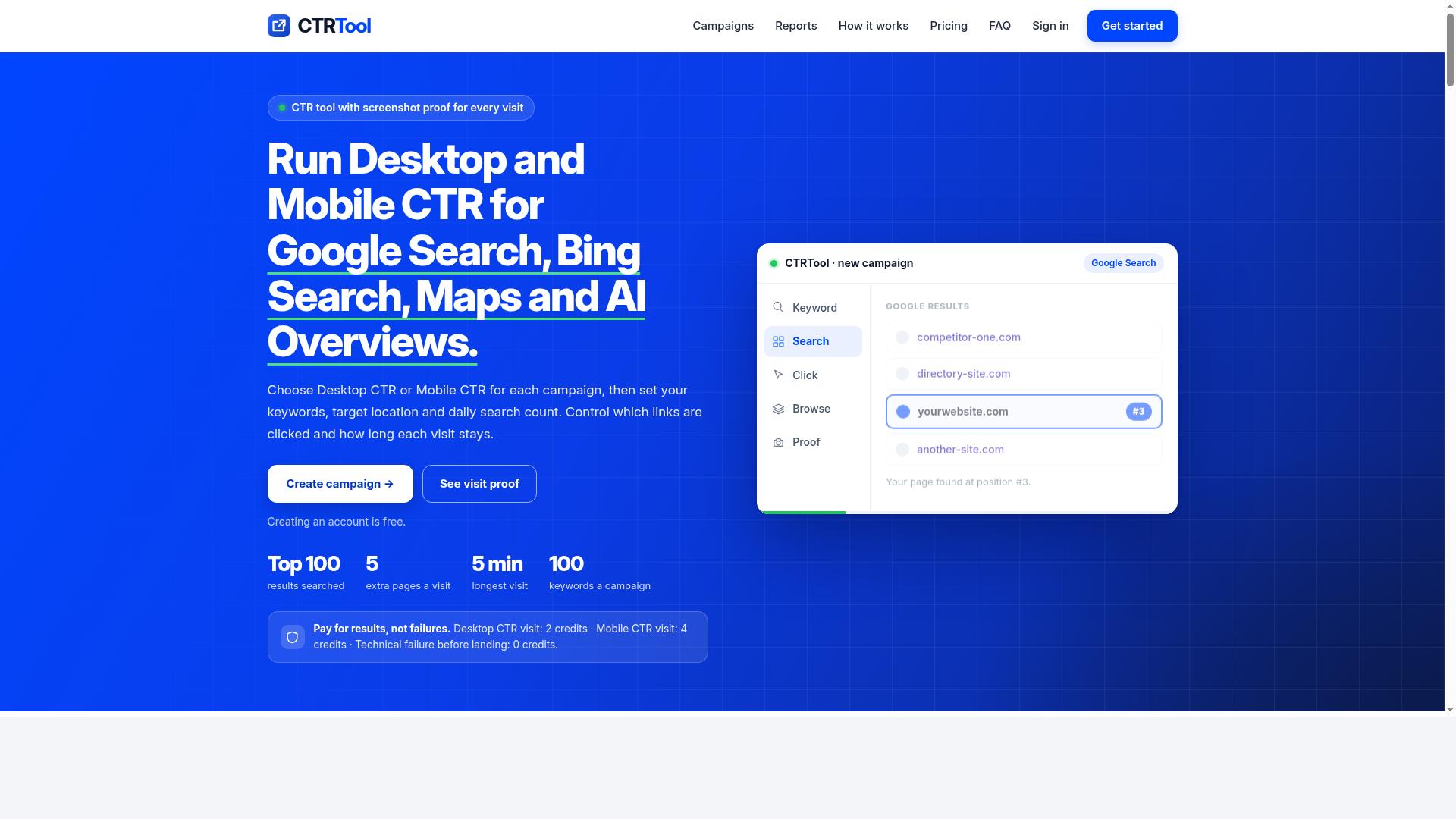
CTRTool is a CTR campaign tool that runs Desktop and Mobile click campaigns for Google Search, Bing Search, Google Maps and AI Overviews, and supplies screenshot proof for every visit. It is built for advertisers and SEO teams who want to shape click-through rate and engagement signals on the pages that matter to them.
Each campaign starts with a clear choice: run it as a Desktop CTR or Mobile CTR campaign. That decision matters because user behavior signals differ by device, and mixing them can blur the picture you are trying to build on search engine results pages.
The platform covers four campaign surfaces. You can point a campaign at:
- Google Search results for your chosen keywords
- Bing Search results, useful for diversifying search visibility
- Google Maps listings, where local intent drives clicks
- AI Overviews, the answer panels now appearing on many queries
For every campaign, you set keywords, a target location and a daily search count. Location targeting can be as broad as a country or as narrow as a state or city, which supports geo-targeting for local campaigns.
One rule shapes how campaigns are built: the target link must sit within the top 100 organic results for its keyword. That keeps campaigns tied to pages that already have some relevance, rather than pushing clicks toward results no searcher would realistically reach.
Proof is part of the offer. CTRTool provides screenshot proof for every visit, so you can review what happened rather than trusting a dashboard total. You also control which links are clicked and how long each visit stays, which lets you work on dwell time and session duration alongside click-through rate.
CTRTool is honest about limits. The site states plainly that automated visits do not guarantee rankings. Treat it as a tool for influencing user behavior signals and testing how engagement shifts, not as a shortcut that replaces sound SEO work.
What Is SerpClix?
SerpClix is generally described as a marketplace where registered users manually perform search-and-click tasks on search engine results pages in exchange for payment. Advertisers submit target keywords and URLs, and the platform distributes those tasks to its pool of clickers.
Because the clicks come from real users rather than automated scripts, SerpClix is often associated with human-driven activity instead of a pure traffic bot. That distinction matters for anyone running AI traffic campaigns, where engagement patterns and user behavior signals can influence how traffic is perceived.
Task execution typically involves a clicker searching for a keyword, locating the target result, and visiting the page. The value of this model depends on how well the platform manages geo-targeting, clicker screening, and activity limits, areas that vary widely across marketplaces.
Details such as supported search engines, the depth of geo-targeting, reporting quality, and how clickers are verified should be checked on SerpClix's own site. Public descriptions rarely capture the full picture, and platform policies can change over time.
For readers weighing CTR tools for AI traffic campaigns, SerpClix represents the manual-clicker model: human labor organized at scale. Whether that model fits a given campaign depends on volume needs, consistency, and budget, which is where the broader comparison with CTRTool becomes relevant.
Features Compared
This comparison focuses on three practical dimensions: coverage of AI Overviews and search engines, the transparency of visit proof and reporting, and the depth of campaign control and targeting. Each subsection walks through what CTRTool documents publicly and sets it beside the general reputation of SerpClix in the same area.
The goal is a structured feature walkthrough rather than a scoreboard, so you can judge which tool fits how you plan and verify AI traffic campaigns. Where SerpClix is concerned, details are described in general terms only, since its public descriptions are less specific. Confirm current capabilities, engine support, and reporting formats on SerpClix's own site before relying on any point below.
AI Overview and Search Coverage
CTRTool explicitly supports AI Overview campaigns alongside Google Search, Bing Search and Google Maps, whereas SerpClix is generally discussed in the context of classic search-engine SERP clicks. That distinction matters most for teams building AI traffic campaigns, where the goal is a click on a source link inside an AI-generated answer.
On the AI Overview side, CTRTool campaigns require a matching citation: the system locates your website in the overview and clicks its source link. This keeps the visit tied to a real citation rather than a generic SERP position. The platform also records AI citation order, so you can see where your source link appeared relative to others.
For standard search, CTRTool covers Google Search CTR and Bing Search CTR, with keywords drawn from the top 100 results. Google Maps CTR is handled separately, checking up to 50 listings across roughly five pages and clicking the business listing's website link.
SerpClix is typically associated with search-engine result clicks, and its public descriptions are not clear on whether AI Overview placements are supported. That is not a claim that it lacks the capability. Treat AI Overview coverage as not clearly established and verify it directly on SerpClix's site.
Proof, Reporting and Visit Transparency
CTRTool provides screenshot proof for every visit, separate search and landing screenshots, plus full visit paths and keyword position tracking over time, including Maps listing order and AI citation order. That level of detail lets you audit a campaign without taking delivery on trust.
The proof stack breaks down into a few concrete pieces:
- Per-visit screenshots captured at the search stage and again on the landing page, stored as separate proof images
- Full visit paths showing the route taken, including up to five additional internal pages and visits of up to five minutes
- Position tracking over time for Search positions, Maps listing order and AI citation order
Because the credit model is pay-for-results, no credits are charged for technical failures before landing, and visits that cannot verify the requested location use no credits. Reporting therefore reflects what was actually delivered.
SerpClix reporting is described only in general terms here. Manual-click marketplaces typically surface task or click confirmations, but the exact proof formats, screenshot availability, and position history should be confirmed on its site. The practical difference is one of specificity: CTRTool documents each visit in detail, while SerpClix's proof depth is less clearly established in public material.
Campaign Control and Targeting
CTRTool lets users choose Desktop CTR or Mobile CTR per campaign, set keyword and location parameters, and target a country with optional state and city or an 'Any country' mix. Desktop delivery runs through Chrome windows, while mobile visits use real Android phone sessions matched to the target location through managed proxy routes.
Control extends to how searches and visits behave. Each campaign supports up to 100 keywords, a search depth up to 100, daily search counts with now, spread out or gap timing, plus defined days, hours and time zone, with daily goals resetting at 00:00 UTC. You can also set the target URL, internal page URLs, link text, click order and scrolling time.
Planning is credit-based across one shared balance. As a control consideration, the Starter plan supports up to 1,000 Desktop or 500 Mobile visits, and full pricing is covered in the Pricing section. Up to 100 campaigns with 100 keywords each are available, and unused credits roll over while subscribed.
SerpClix targeting is described generally. Manual-click platforms often offer country-level selection, but the depth of state and city options, device choice, and timing controls should be verified on its site. CTRTool's advantage here is the granularity of location and scheduling combined with a single balance across campaign types.
Pricing Compared
CTRTool publishes monthly USD plans-Starter at $59/month for 2,000 credits (up to 1,000 Desktop or 500 Mobile CTR visits) and Growth at $125/month for 5,000 credits (up to 2,500 Desktop or 1,250 Mobile visits)-while SerpClix pricing should be checked directly on its site. The table below shows the full CTRTool lineup, including the higher tiers.
| Plan | Monthly Price | Credits | Max Desktop Visits | Max Mobile Visits |
|---|---|---|---|---|
| Starter | $59 | 2,000 | 1,000 | 500 |
| Growth (Recommended) | $125 | 5,000 | 2,500 | 1,250 |
| Scale | $399 | 20,000 | 10,000 | 5,000 |
| Agency | $699 | 40,000 | 20,000 | 10,000 |
The credit model matters because Desktop and Mobile visits cost different amounts. A Desktop CTR visit uses 2 credits, while a Mobile CTR visit uses 4 credits, so the same credit balance buys half as many mobile visits. A verified search without a match costs 1 credit, and a technical failure before landing costs 0 credits.
Unused credits roll over while your subscription stays active and expire when cancellation takes effect. Creating an account is free, and custom development carries a separate, agreed one-time fee.
SerpClix operates on a credit- or task-based model, but its exact prices and credit costs should be verified on SerpClix's official pricing page rather than assumed. The practical comparison is cost per verified visit, not the sticker price, since visit types and verification rules differ between CTR tools.
Who Should Choose CTRTool
CTRTool fits SEO practitioners and agencies who need auditable, screenshot-backed visits across Google Search, Bing, Maps and AI Overviews for their own or client sites.
That focus on evidence separates it from tools built mainly around manual clickers and proxy rotation. If your campaign has to survive a client review or an internal audit, the proof matters as much as the click itself.
Three profiles tend to get the most from it:
- Agencies needing client-ready proof. Screenshot-backed visit records give account managers something concrete to show at reporting time, rather than asking a client to trust a dashboard total.
- Teams targeting AI Overviews or Maps listings. CTRTool supports campaigns aimed at AI Overviews and includes Maps listing checks up to 50, which suits local and visibility-focused work.
- Operators who want granular control. Desktop and Mobile targeting plus geo-targeting down to city level let you shape a campaign around the markets and devices that actually matter to a keyword ranking.
- Practitioners working across multiple engines. Coverage of Google Search, Bing Search, Google Maps and AI Overviews means one workflow instead of several disconnected tools.
If your priority is simply the lowest possible cost per click with minimal setup, a leaner manual-clicker service may feel adequate. But when the deliverable is defensible evidence of search visibility work, CTRTool's structure is the better fit.
Who Should Choose SerpClix
SerpClix may suit buyers who prefer a general manual-click marketplace for classic SERP tasks and who do not require per-visit screenshot proof. That framing matters because the platform is typically understood as a marketplace model, where availability and delivery can shift with supply and demand.
Three reader profiles tend to fit this option:
- Experimenters running small, low-stakes tests of manual-click traffic before committing to a dedicated CTR tool.
- Marketplace-tolerant buyers who accept variability in clicker supply, timing, and consistency as part of the model.
- Narrow-scope users whose needs stop at standard clicks on search engine results pages such as Google, Bing, or Yahoo, with no deeper campaign controls.
If your AI traffic campaigns depend on verifiable delivery, per-visit evidence, or tighter control over geo-targeting and user behavior signals, a marketplace approach may feel limiting. Confirm current capabilities, coverage, and terms directly on SerpClix's site before deciding.
Final Verdict
For AI traffic campaigns that demand verifiable outcomes, CTRTool's screenshot proof for every visit, AI Overview support and published USD pricing make it the clearer choice, while SerpClix remains a general manual-click option to evaluate on its own site.
The decisive factor is proof transparency. CTRTool delivers search and landing screenshots as separate proof images for every visit, along with full visit paths and keyword positions tracked over time, including Maps listing order and AI citation order. That level of documentation lets you confirm what a visit actually looked like on the search engine results pages.
Coverage and control matter just as much. CTRTool supports campaigns across Google, Bing, Maps and AI Overviews, with Desktop and Mobile options and geo-targeting built into the campaign setup. Visits that cannot verify the requested location use no credits, which keeps spend tied to real outcomes.
Pricing is another differentiator. CTRTool publishes its plans openly, with Starter at $59 and Growth at $125, and its pay-for-results credit model charges nothing for technical failures before landing. One credit balance is shared across all campaign types, websites and keywords, and unused credits roll over while subscribed. SerpClix specifics, by contrast, should be verified directly on its own site before you commit.
The recommendation is straightforward. If you need auditable proof, AI Overview coverage and predictable published pricing for AI traffic campaigns, review CTRTool's plans next and map them against your campaign volume and keyword count.
Frequently Asked Questions
What is the main difference between SerpClix and CTRTool?
SerpClix is a crowdsourced platform where paid "clickers" manually perform search visits, while CTRTool is a CTR campaign tool built for Google Search, Bing Search, Maps and AI Overviews that provides screenshot proof for every visit. CTRTool also tracks keyword positions over time, including Maps listing order and AI citation order, so you can verify results rather than take them on trust.
Does CTRTool provide proof that visits actually happened?
Yes. Screenshot proof is a core part of CTRTool: every visit comes with search and landing screenshots as separate proof images, plus full visit paths. This lets SEO practitioners and agencies confirm that each campaign visit was completed as specified.
Which platforms and campaign types does CTRTool support?
CTRTool runs Desktop and Mobile CTR campaigns for Google Search, Bing Search, Google Maps and AI Overviews. You choose Desktop CTR or Mobile CTR per campaign, set your keywords and target location, and can target a country with an optional state and city, or "Any country" for a mix of supported locations.
How does CTRTool's pricing work compared with SerpClix?
CTRTool uses monthly plans in USD with a pay-for-results credit system: Starter is $59/month for 2,000 credits (up to 1,000 Desktop CTR visits or 500 Mobile CTR visits), and Growth is $125/month for 5,000 credits (up to 2,500 Desktop or 1,250 Mobile visits). SerpClix does not publish buyer pricing or plan names in the sources reviewed, so a direct cost comparison isn't possible from available information.
Can I target specific locations and keywords with these tools?
With CTRTool, yes - campaigns are built around your chosen keywords and target location, down to state and city level, or "Any country" for a mix of supported locations. For SerpClix, the researched facts describe manual search visits by paid clickers but do not detail its targeting options, so check their site directly if granular location targeting matters to you.
Which tool is better for agencies running client campaigns?
CTRTool is aimed at SEO practitioners and agencies running CTR campaigns for their own or client websites, with screenshot proof and position tracking that support client reporting. SerpClix's documented model centers on paying clickers up to $0.10 per click, with payouts via PayPal at the start of each month once an account has earned at least $5.00 - a different structure that may suit different workflows.